02 // SELECTED WORK // CASE STUDY 02
Tapestree.
Change governance without the bureaucracy.
A multi-tenant operational change workspace for lean IT teams. Tapestree is my exploration of how good governance, usable workflows, and the right engineering controls can coexist without making everyday operations harder.
Independent product · Private source repository · Active development · Public demo and domain pending
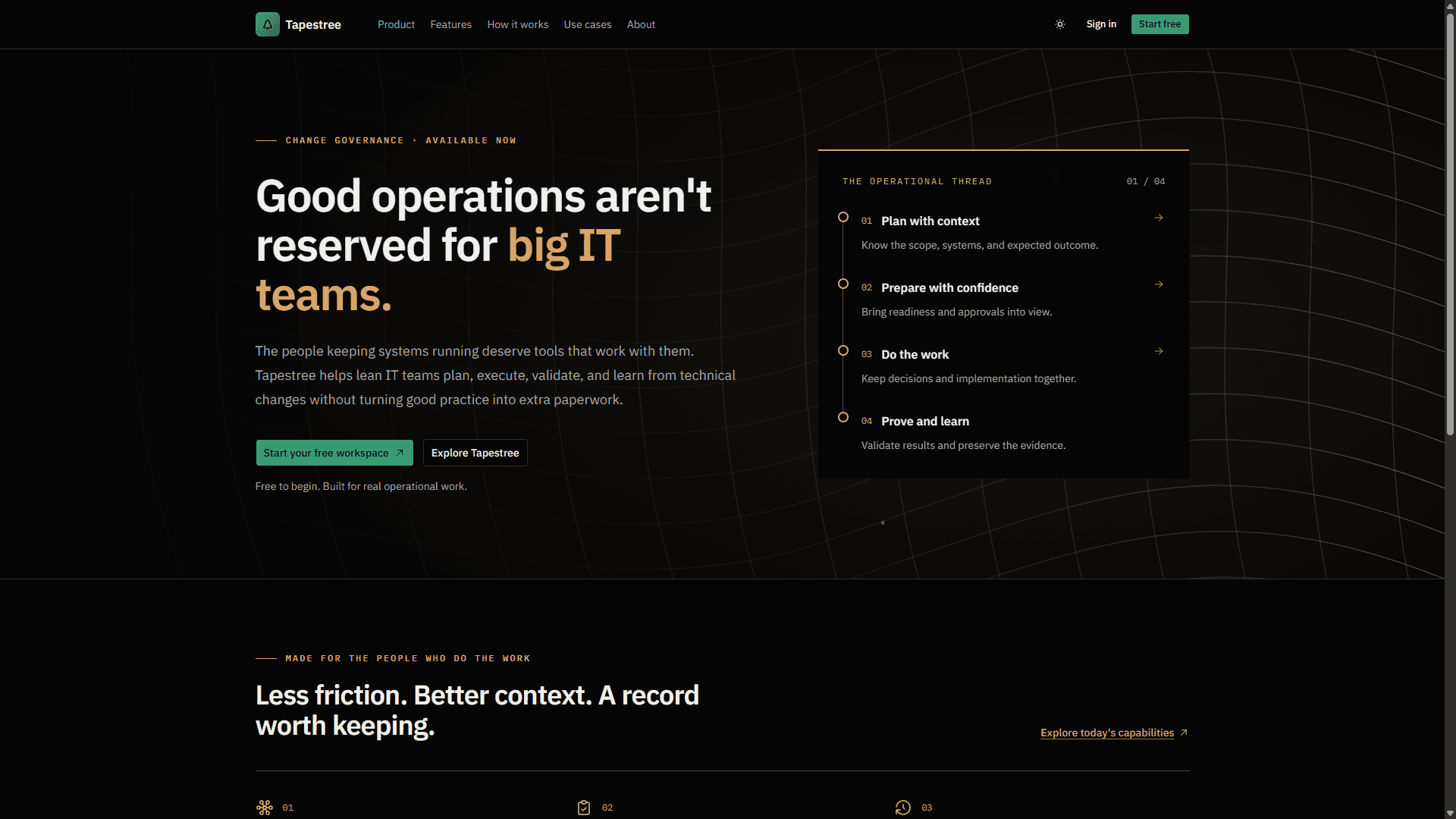
Important changes shouldn't depend on someone's memory.
Small IT teams routinely make changes that carry real operational risk. The work might be technically straightforward, but the surrounding questions still matter: who owns it, what depends on it, how will success be checked, and where will the evidence live?
Heavyweight change-management systems can become a process of their own. I wanted to explore a more practical approach: enough structure to preserve accountability and institutional knowledge, without adding unnecessary friction.
Tapestree began with change governance as the first product focus. Its broader direction is operational intelligence for lean IT teams, but those future capabilities aren't presented here as shipped features.
A change is more than an approval.
From preparation through validation, the lifecycle needs to preserve useful context for the people doing the work and the people who inherit it later.
WORKFLOW OVERVIEW // PLAN THROUGH COMPLETION
Plan
Capture scope, affected systems, risk, and the intended outcome.
Prepare
Define prerequisites, coordination, and validation criteria.
Execute
Record the work and preserve a useful history of what happened.
Validate
Check the outcome against the criteria established beforehand.
Complete
Close the change with evidence, context, and lessons worth retaining.
The surrounding workspace matters, too.
The current implementation includes more than the change record itself. Organization-scoped discovery, operational context, evidence, and administration provide the structure around the lifecycle.
Change workspace
Create and manage changes through a structured lifecycle, with ownership, participants, dependencies, preparation, and validation.
Systems & resources
Connect changes to the systems and resources they affect instead of treating each record as an isolated ticket.
Evidence & history
Keep execution records, evidence, terminal outcomes, and lessons linked to the operational work.
Organization controls
Apply organization-scoped permissions, member administration, audit history, and tenant-aware access boundaries.
Multi-tenancy changes the design decisions.
Building a product for multiple organizations makes authorization, data isolation, reproducibility, and deployment boundaries first-class engineering concerns.
Next.js · React · TypeScript
App Router, typed components, UI workflows, and server-driven discovery.
Supabase · PostgreSQL
Relational data, authentication, storage, authorization, and tenant isolation.
Azure · Docker · GitHub Actions
Container Apps, Container Registry, Key Vault, managed identity, and OIDC-based delivery.
Playwright · pgTAP
Browser acceptance tests and database-level contracts for critical behavior.
Authorization by design
Organization-scoped data access and configurable roles are part of the system model, not just navigation or interface rules.
Database contracts
PostgreSQL migrations and pgTAP tests support predictable schema evolution and protect access boundaries.
Cloud delivery
Azure Container Apps and registry, infrastructure definitions, and OIDC-based GitHub Actions deployment make environments reproducible.
Behavioral verification
Playwright end-to-end tests exercise real workflows while representative local seed data makes complex states reproducible.
Good governance should make work easier to do well.
Keep the workflow grounded in real operations. Planning, preparation, execution, validation, and lessons are more useful than treating an approval as the whole change process.
Permission models shape the product. Multi-tenant software requires consistent access boundaries across the database, server behavior, and user experience.
Reproducible systems support iteration. Database tests, browser tests, seeded environments, and infrastructure automation let the product evolve with greater confidence.
Built to keep evolving.
Change governance remains Tapestree's first native product pillar. The longer-term operational intelligence vision is a direction for the platform, not a claim about functionality available today.